
NCOD Design Guidelines Update

The Neighborhood Conservation Overlay District (NCOD) has been in place since 1991 and contains over 4,000 properties and nine National Register Historic Districts located in and around Bozeman's historic downtown core. The NCOD was created to stimulate the restoration and rehabilitation of structures while also inviting new construction that enhances the character and function of the area. The Bozeman Guidelines for Historic Preservation and the Neighborhood Conservation Overlay District (NCOD) were originally adopted in 2006 and has a minor update in 2015.
This project aims to update the design guidelines to consider current best practices in historic preservation, respond to community goals and values, and support the ongoing Local Landmark Project.
This project page will serve as your go-to resource for updates on how to engage in person, virtually, or at your convenience. You can stay informed by subscribing to email updates specific to this project by subscribing on the right-hand side of this page. We appreciate your active participation and involvement in this important endeavor!
The Neighborhood Conservation Overlay District (NCOD) has been in place since 1991 and contains over 4,000 properties and nine National Register Historic Districts located in and around Bozeman's historic downtown core. The NCOD was created to stimulate the restoration and rehabilitation of structures while also inviting new construction that enhances the character and function of the area. The Bozeman Guidelines for Historic Preservation and the Neighborhood Conservation Overlay District (NCOD) were originally adopted in 2006 and has a minor update in 2015.
This project aims to update the design guidelines to consider current best practices in historic preservation, respond to community goals and values, and support the ongoing Local Landmark Project.
This project page will serve as your go-to resource for updates on how to engage in person, virtually, or at your convenience. You can stay informed by subscribing to email updates specific to this project by subscribing on the right-hand side of this page. We appreciate your active participation and involvement in this important endeavor!
-
Update on City Commission Direction
Share Update on City Commission Direction on Facebook Share Update on City Commission Direction on X (formerly Twitter) Share Update on City Commission Direction on Linkedin Email Update on City Commission Direction linkWelcome to smoke season, or as it is more commonly known outside of Montana, August. In our last project update, we shared that we would be seeking direction from City Commission at their July 28 meeting. With big important projects like this one, it's good to check in periodically to ensure the direction we're heading continues to align with Commission's vision. In recent months, we had started to hear from community members engaging on this project that perhaps we were off course, and that was all the more reason to double check. You can watch a recording of the presentation and Commission discussion on the City's website (jump ahead in the video to the 1:01:30 timestamp, when this topic begins). A summary of several key takeaways is provided in this update.
In our presentation to Commission, the project team asked three main questions to help guide next steps on this project and the ongoing Local Landmark Project.
(1) Do you agree with the proposed sequence of work?
Our first question related to the sequence of work. You may recall that the Historic Preservation Advisory Board (HPAB) was working through these projects one piece at a time, with the NCOD Design Standards update and revisions to demolition regulations currently before them. With the loss of our project consultant for the NCOD Design Standards, we wanted to revisit our order of operations to ensure work can continue to move forward while we seek a new consultant.
Initially, Commission agreed that revisions to our historic preservation code sections should come first, followed by the NCOD Design Standards update, then development of a Local Landmark Program. This was the order HPAB preferred when we asked them earlier this year. After some discussion, however, Commission suggested that a Local Landmark Program may be a way to help tailor and apply design standards more precisely to specific designated areas as opposed to the whole NCOD. Leading up to this discussion, we had been working toward an approach that incorporated tiers into the revised design standards. The tiered approach would have achieved a similar outcome (applying design standards differently in different areas) but may have been more complicated to implement. Commission told us that it may make sense to finish developing a Local Landmark Program that lays out the process for nominating and designating landmark districts before we finish updating the design standards. This sequence is further supported by the fact that we have an active contract with the consultant (Community Planning Collaborative) working on both the code revisions and Local Landmark Program.
What this means is that the NCOD Design Standards update will take a backseat temporarily while work continues on code revisions and development of a Local Landmark Program. It's important to remember that updating the design standards is still a priority for all the reasons we have explained since we started this work, and we are committed to picking the project back up as soon as possible. We anticipate seeking a new consultant toward the end of this year, but will not have further community engagement opportunities (including with our neighborhood focus group) on this project until that time.
(2) Do you want to modify the dimensional standards that are established in base zoning through application of the neighborhood conservation overlay district?
Many comments received through our community engagement on this project emphasized the importance of compatible building form, especially height, width, and setbacks. These aspects of building design are regulated through standards and limitations within existing base zoning. For example, in our current Unified Development Code (UDC), every zoning district has a regulatory height limit. These standards and limitations were recently reviewed through the multi-year effort to update the UDC. We wanted to understand from Commission whether they intended that the standards and limitations in base zoning would be further modified in one area of the city by an overlay district (the NCOD). A majority of commissioners were not in favor of modifying dimensional standards (such as the height and width of buildings) via an overlay district. They expressed a preference to address issues and concerns about building bulk and mass by making sure the base zoning itself is appropriate, both in what is allowed in a zoning district and where the districts are applied within the city. This conversation will continue as Commission and numerous city boards consider height limitations in the B-3 zoning district.
What this means for the NCOD Design Standards is that standards and guidelines will likely focus on aspects of building design not already regulated through base zoning. This could include things like roofline/pitch or building modulation, in addition to architectural design elements. Again, we will pick this conversation back up later this year as we seek a new project consultant.
(3) What outcome(s) do you want to see from regulating the demolition of structures?
As we continue to work with HPAB on revisions to our demolition regulations, we took this opportunity to ask Commission about their goals. They echoed many of the recommendations previously provided by HPAB. This topic will be discussed further at the upcoming HPAB meeting on August 19.
What this means is that work on code revisions will continue to be our top priority. Updating our historic preservation regulations will bring them up to date with best practices and community values. The project team is working on demolition code first at the direction of HPAB and we look forward to reviewing proposed revisions together this fall.
---
Thanks for your continued interest in these projects! In the next few months, project updates related to code revisions and the Local Landmark Program will be posted on the Engage page for the Local Landmark Project. Make sure to follow along there to stay current with our historic preservation work! We'll be sure to post an update here when we're ready to resume work on the NCOD Design Standards with a new consultant team.
Welcome to smoke season, or as it is more commonly known outside of Montana, August. In our last project update, we shared that we would be seeking direction from City Commission at their July 28 meeting. With big important projects like this one, it's good to check in periodically to ensure the direction we're heading continues to align with Commission's vision. In recent months, we had started to hear from community members engaging on this project that perhaps we were off course, and that was all the more reason to double check. You can watch a recording of the presentation and Commission discussion on the City's website (jump ahead in the video to the 1:01:30 timestamp, when this topic begins). A summary of several key takeaways is provided in this update.
In our presentation to Commission, the project team asked three main questions to help guide next steps on this project and the ongoing Local Landmark Project.
(1) Do you agree with the proposed sequence of work?
Our first question related to the sequence of work. You may recall that the Historic Preservation Advisory Board (HPAB) was working through these projects one piece at a time, with the NCOD Design Standards update and revisions to demolition regulations currently before them. With the loss of our project consultant for the NCOD Design Standards, we wanted to revisit our order of operations to ensure work can continue to move forward while we seek a new consultant.
Initially, Commission agreed that revisions to our historic preservation code sections should come first, followed by the NCOD Design Standards update, then development of a Local Landmark Program. This was the order HPAB preferred when we asked them earlier this year. After some discussion, however, Commission suggested that a Local Landmark Program may be a way to help tailor and apply design standards more precisely to specific designated areas as opposed to the whole NCOD. Leading up to this discussion, we had been working toward an approach that incorporated tiers into the revised design standards. The tiered approach would have achieved a similar outcome (applying design standards differently in different areas) but may have been more complicated to implement. Commission told us that it may make sense to finish developing a Local Landmark Program that lays out the process for nominating and designating landmark districts before we finish updating the design standards. This sequence is further supported by the fact that we have an active contract with the consultant (Community Planning Collaborative) working on both the code revisions and Local Landmark Program.
What this means is that the NCOD Design Standards update will take a backseat temporarily while work continues on code revisions and development of a Local Landmark Program. It's important to remember that updating the design standards is still a priority for all the reasons we have explained since we started this work, and we are committed to picking the project back up as soon as possible. We anticipate seeking a new consultant toward the end of this year, but will not have further community engagement opportunities (including with our neighborhood focus group) on this project until that time.
(2) Do you want to modify the dimensional standards that are established in base zoning through application of the neighborhood conservation overlay district?
Many comments received through our community engagement on this project emphasized the importance of compatible building form, especially height, width, and setbacks. These aspects of building design are regulated through standards and limitations within existing base zoning. For example, in our current Unified Development Code (UDC), every zoning district has a regulatory height limit. These standards and limitations were recently reviewed through the multi-year effort to update the UDC. We wanted to understand from Commission whether they intended that the standards and limitations in base zoning would be further modified in one area of the city by an overlay district (the NCOD). A majority of commissioners were not in favor of modifying dimensional standards (such as the height and width of buildings) via an overlay district. They expressed a preference to address issues and concerns about building bulk and mass by making sure the base zoning itself is appropriate, both in what is allowed in a zoning district and where the districts are applied within the city. This conversation will continue as Commission and numerous city boards consider height limitations in the B-3 zoning district.
What this means for the NCOD Design Standards is that standards and guidelines will likely focus on aspects of building design not already regulated through base zoning. This could include things like roofline/pitch or building modulation, in addition to architectural design elements. Again, we will pick this conversation back up later this year as we seek a new project consultant.
(3) What outcome(s) do you want to see from regulating the demolition of structures?
As we continue to work with HPAB on revisions to our demolition regulations, we took this opportunity to ask Commission about their goals. They echoed many of the recommendations previously provided by HPAB. This topic will be discussed further at the upcoming HPAB meeting on August 19.
What this means is that work on code revisions will continue to be our top priority. Updating our historic preservation regulations will bring them up to date with best practices and community values. The project team is working on demolition code first at the direction of HPAB and we look forward to reviewing proposed revisions together this fall.
---
Thanks for your continued interest in these projects! In the next few months, project updates related to code revisions and the Local Landmark Program will be posted on the Engage page for the Local Landmark Project. Make sure to follow along there to stay current with our historic preservation work! We'll be sure to post an update here when we're ready to resume work on the NCOD Design Standards with a new consultant team.
-
Project Update & Next Steps
Share Project Update & Next Steps on Facebook Share Project Update & Next Steps on X (formerly Twitter) Share Project Update & Next Steps on Linkedin Email Project Update & Next Steps linkSince our last update, we closed the online survey and have been combing through responses and developing next steps based on all the community feedback we have received to date. The survey results are available for download on the project’s Engage web page. We met with the Neighborhood Focus Group on July 9 and the Historic Preservation Advisory Board (HPAB) on July 15 to share a summary of engagement and a first look at several draft work products. You can view the HPAB meeting materials or watch the meeting recording online.
Through these updates, we wanted to understand whether the groups felt we were on the right path with our proposed approach as well as the level of detail and formatting of the draft documents. Both meetings were opportunities to check in and hear from the folks who are helping to guide this project. We walked away from the meetings with a clear sense that we need to circle back to City Commission to make sure the project aligns with their vision, and then invest more time in addressing community expectations. That conversation will begin with a Commission work session on 7/28.
Unfortunately, we also walked away from the HPAB meeting knowing we had to make the difficult decision to terminate our contract with the Lakota Group due to unprofessional conduct during the meeting. This decision was not made lightly, and we know that losing our consultants will impact the project. This is a project that many people care deeply about. You all have spent countless hours with us in focus groups, on surveys, at open houses, at board meetings, and more, giving your thoughts on how this update should move forward. One of the things we have heard from neighbors is concern over the project goals, and this action also allows us to reassess, have further discussions at City Commission, and chart a path forward that feels better to all.
The work of updating the NCOD Design Guidelines is important, and there has been great momentum and discussion happening over the past few months. We plan on keeping that momentum going in the coming weeks and months as we continue our historic preservation work through the Local Landmark Project. That work is currently focused on revisions to the City’s demolition regulations. Tune into the City Commission meeting on 7/28 to learn about next steps for both projects.
We will do our best to you all updated, and you can rest assured that there will be more opportunities to get involved and shape what this update looks like. Thanks for being on this journey with us and for your understanding in this tough decision.
Since our last update, we closed the online survey and have been combing through responses and developing next steps based on all the community feedback we have received to date. The survey results are available for download on the project’s Engage web page. We met with the Neighborhood Focus Group on July 9 and the Historic Preservation Advisory Board (HPAB) on July 15 to share a summary of engagement and a first look at several draft work products. You can view the HPAB meeting materials or watch the meeting recording online.
Through these updates, we wanted to understand whether the groups felt we were on the right path with our proposed approach as well as the level of detail and formatting of the draft documents. Both meetings were opportunities to check in and hear from the folks who are helping to guide this project. We walked away from the meetings with a clear sense that we need to circle back to City Commission to make sure the project aligns with their vision, and then invest more time in addressing community expectations. That conversation will begin with a Commission work session on 7/28.
Unfortunately, we also walked away from the HPAB meeting knowing we had to make the difficult decision to terminate our contract with the Lakota Group due to unprofessional conduct during the meeting. This decision was not made lightly, and we know that losing our consultants will impact the project. This is a project that many people care deeply about. You all have spent countless hours with us in focus groups, on surveys, at open houses, at board meetings, and more, giving your thoughts on how this update should move forward. One of the things we have heard from neighbors is concern over the project goals, and this action also allows us to reassess, have further discussions at City Commission, and chart a path forward that feels better to all.
The work of updating the NCOD Design Guidelines is important, and there has been great momentum and discussion happening over the past few months. We plan on keeping that momentum going in the coming weeks and months as we continue our historic preservation work through the Local Landmark Project. That work is currently focused on revisions to the City’s demolition regulations. Tune into the City Commission meeting on 7/28 to learn about next steps for both projects.
We will do our best to you all updated, and you can rest assured that there will be more opportunities to get involved and shape what this update looks like. Thanks for being on this journey with us and for your understanding in this tough decision.
-
Engagement Survey Open Through June 30
Share Engagement Survey Open Through June 30 on Facebook Share Engagement Survey Open Through June 30 on X (formerly Twitter) Share Engagement Survey Open Through June 30 on Linkedin Email Engagement Survey Open Through June 30 link
Work continues on the project to update the design standards and guidelines that apply within the Neighborhood Conservation Overlay District (NCOD). The project team has been busy reviewing the feedback you provided during our busy engagement week in April. Through the community open house, neighborhood tours, stakeholder listening sessions, and meetings with a neighborhood focus group and the Historic Preservation Advisory Board (HPAB), we gathered valuable information and perspectives that will shape the project's next steps.
If you have been following along, thank you for your time and attention! We have received excellent input to date, but we recognize that not all community members were able to join us at one of the in-person events this spring.
Online Survey Now Open!
We included a survey in the community engagement plan at the recommendation of the HPAB to supplement in-person feedback and emailed public comments, and help ensure we reach as many interested community members as possible. As with all of our engagement efforts related to this project, we want to better understand what's working and what could be improved in the way the City regulates building design in our historic downtown and surrounding neighborhoods. The survey provides an opportunity for folks to engage virtually with the same topics that were covered at the in-person open house and discussed in more depth with the neighborhood focus group.
Already joined us in person? Great! You are welcome to use the survey to add any additional thoughts you may have or jump ahead to the last few questions related to visual preferences. And if you know someone who has not yet shared their perspectives, please don't be shy about forwarding this update.
Take the NCOD Engagement Survey
The survey will be open through June 30, 2026.We hope this survey provides a meaningful opportunity to get involved as we continue to compile comments and organize our thoughts about how your feedback informs where we will go next. Looking ahead, we will discuss public engagement and next steps with the neighborhood focus group in late-June/early-July and report out at the regular HPAB meeting on July 15, 2026.
Until then, please share the survey broadly and tune in for updates on the Local Landmark Project.
Thank you!
Received this update from a friend or mailing list? Subscribe on the project page to make sure you don't miss future updates: https://engage.bozemanmt.gov/ncodupdate
Work continues on the project to update the design standards and guidelines that apply within the Neighborhood Conservation Overlay District (NCOD). The project team has been busy reviewing the feedback you provided during our busy engagement week in April. Through the community open house, neighborhood tours, stakeholder listening sessions, and meetings with a neighborhood focus group and the Historic Preservation Advisory Board (HPAB), we gathered valuable information and perspectives that will shape the project's next steps.
If you have been following along, thank you for your time and attention! We have received excellent input to date, but we recognize that not all community members were able to join us at one of the in-person events this spring.
Online Survey Now Open!
We included a survey in the community engagement plan at the recommendation of the HPAB to supplement in-person feedback and emailed public comments, and help ensure we reach as many interested community members as possible. As with all of our engagement efforts related to this project, we want to better understand what's working and what could be improved in the way the City regulates building design in our historic downtown and surrounding neighborhoods. The survey provides an opportunity for folks to engage virtually with the same topics that were covered at the in-person open house and discussed in more depth with the neighborhood focus group.
Already joined us in person? Great! You are welcome to use the survey to add any additional thoughts you may have or jump ahead to the last few questions related to visual preferences. And if you know someone who has not yet shared their perspectives, please don't be shy about forwarding this update.
Take the NCOD Engagement Survey
The survey will be open through June 30, 2026.We hope this survey provides a meaningful opportunity to get involved as we continue to compile comments and organize our thoughts about how your feedback informs where we will go next. Looking ahead, we will discuss public engagement and next steps with the neighborhood focus group in late-June/early-July and report out at the regular HPAB meeting on July 15, 2026.
Until then, please share the survey broadly and tune in for updates on the Local Landmark Project.
Thank you!
Received this update from a friend or mailing list? Subscribe on the project page to make sure you don't miss future updates: https://engage.bozemanmt.gov/ncodupdate
-
Engagement Week Follow Up - Thank You!
Share Engagement Week Follow Up - Thank You! on Facebook Share Engagement Week Follow Up - Thank You! on X (formerly Twitter) Share Engagement Week Follow Up - Thank You! on Linkedin Email Engagement Week Follow Up - Thank You! linkWow, what a week! If you have been following along, you know that the city's consultant team for the Design Guidelines Update Project, the Lakota Group, was in Bozeman last week touring the Neighborhood Conservation Overlay District (NCOD) and listening to a variety of voices and perspectives. We want to extend a big thank you to everyone who took time out of their week to attend an event. Whether it was the open house, a walking tour, the neighborhood focus group, or a stakeholder listening session, your participation is a meaningful investment in this project and our city. Thank you!
We wrapped up our intensive community engagement with a long conversation with the Historic Preservation Advisory Board (HPAB) on Wednesday evening. At the meeting, the Lakota Group team shared their first impressions and reflected on what they heard throughout the engagement sessions before gathering input from board members. You can watch a recording of the HPAB meeting to hear their discussion.
The team is now hard at work transcribing comments and compiling notes. We look forward to sharing an update with you in the coming weeks. In the meantime, if you missed the events last week, presentation slides from the Community Open House are available in the documents on this page and you may always submit written comments to share your thoughts. Simply send an email to comments@bozeman.net and mention the NCOD Design Guidelines Project. Staff will make sure all feedback is passed along to the Lakota Group team.
We are also continuing to collaborate with the consultant team for the related Local Landmark Project to ensure both efforts are aligned moving forward. There is significant overlap between the two projects and if you're interested in historic preservation, we hope you'll stay engaged in both as they move forward this year.
Wow, what a week! If you have been following along, you know that the city's consultant team for the Design Guidelines Update Project, the Lakota Group, was in Bozeman last week touring the Neighborhood Conservation Overlay District (NCOD) and listening to a variety of voices and perspectives. We want to extend a big thank you to everyone who took time out of their week to attend an event. Whether it was the open house, a walking tour, the neighborhood focus group, or a stakeholder listening session, your participation is a meaningful investment in this project and our city. Thank you!
We wrapped up our intensive community engagement with a long conversation with the Historic Preservation Advisory Board (HPAB) on Wednesday evening. At the meeting, the Lakota Group team shared their first impressions and reflected on what they heard throughout the engagement sessions before gathering input from board members. You can watch a recording of the HPAB meeting to hear their discussion.
The team is now hard at work transcribing comments and compiling notes. We look forward to sharing an update with you in the coming weeks. In the meantime, if you missed the events last week, presentation slides from the Community Open House are available in the documents on this page and you may always submit written comments to share your thoughts. Simply send an email to comments@bozeman.net and mention the NCOD Design Guidelines Project. Staff will make sure all feedback is passed along to the Lakota Group team.
We are also continuing to collaborate with the consultant team for the related Local Landmark Project to ensure both efforts are aligned moving forward. There is significant overlap between the two projects and if you're interested in historic preservation, we hope you'll stay engaged in both as they move forward this year.
-
Neighborhood Walking Tours April 14 & 15
Share Neighborhood Walking Tours April 14 & 15 on Facebook Share Neighborhood Walking Tours April 14 & 15 on X (formerly Twitter) Share Neighborhood Walking Tours April 14 & 15 on Linkedin Email Neighborhood Walking Tours April 14 & 15 linkAs we seek to engage, educate, and hear from the community about efforts to update the design guidelines that apply to the more than 4,000 properties within the Neighborhood Conservation Overlay District (NCOD), we're excited to announce two opportunities to explore Bozeman's downtown neighborhoods with the project team.
The public is invited to join us for these unique opportunities to tour parts of the NCOD, learning about historic structures and the City's design review process as we stroll. The NCOD is too large to walk in its entirety, so the two tours will focus on different subsets of the area that each contain a variety of sites of interest. We hope you will consider participating, whether you have experiences in the area to share or just want to listen and learn. These are sure to be filled with interesting commentary to consider!
Northeast Neighborhood Tour - Tuesday, April 14, at 3-5pm
Representatives of the Northeast Neighborhood Association will guide the group around sites in their neighborhood. City staff will be on hand and the Lakota Group team will also be present to lend their expertise to the discussion.
We will meet at the southeast corner of Centennial Park and walk south along N Tracy Ave toward Main Street, viewing historic homes and newer development along the way before looping back north along N Willson Ave.
South Central Neighborhood Tour - Wednesday, April 15, at 9-11am
This tour will explore the South Central Neighborhood. The City's Planning Manager will highlight historic structures and structures that went through the design review process and discuss how the design guidelines affected the building design.
We will meet outside Ghost Town Coffee Roasters at 110 E Olive St and discuss the Black Olive Building before walking south along S Black Ave and S Tracy Ave.
Please dress for two hours of walking in whatever weather comes our way.Not able to join? The project team is exploring additional future opportunities and accessible engagement strategies, including self-guided or virtual neighborhood tours. We're interested in hearing your ideas and suggestions as well.
As we seek to engage, educate, and hear from the community about efforts to update the design guidelines that apply to the more than 4,000 properties within the Neighborhood Conservation Overlay District (NCOD), we're excited to announce two opportunities to explore Bozeman's downtown neighborhoods with the project team.
The public is invited to join us for these unique opportunities to tour parts of the NCOD, learning about historic structures and the City's design review process as we stroll. The NCOD is too large to walk in its entirety, so the two tours will focus on different subsets of the area that each contain a variety of sites of interest. We hope you will consider participating, whether you have experiences in the area to share or just want to listen and learn. These are sure to be filled with interesting commentary to consider!
Northeast Neighborhood Tour - Tuesday, April 14, at 3-5pm
Representatives of the Northeast Neighborhood Association will guide the group around sites in their neighborhood. City staff will be on hand and the Lakota Group team will also be present to lend their expertise to the discussion.
We will meet at the southeast corner of Centennial Park and walk south along N Tracy Ave toward Main Street, viewing historic homes and newer development along the way before looping back north along N Willson Ave.
South Central Neighborhood Tour - Wednesday, April 15, at 9-11am
This tour will explore the South Central Neighborhood. The City's Planning Manager will highlight historic structures and structures that went through the design review process and discuss how the design guidelines affected the building design.
We will meet outside Ghost Town Coffee Roasters at 110 E Olive St and discuss the Black Olive Building before walking south along S Black Ave and S Tracy Ave.
Please dress for two hours of walking in whatever weather comes our way.Not able to join? The project team is exploring additional future opportunities and accessible engagement strategies, including self-guided or virtual neighborhood tours. We're interested in hearing your ideas and suggestions as well.
-
Community Open House on April 13
Share Community Open House on April 13 on Facebook Share Community Open House on April 13 on X (formerly Twitter) Share Community Open House on April 13 on Linkedin Email Community Open House on April 13 link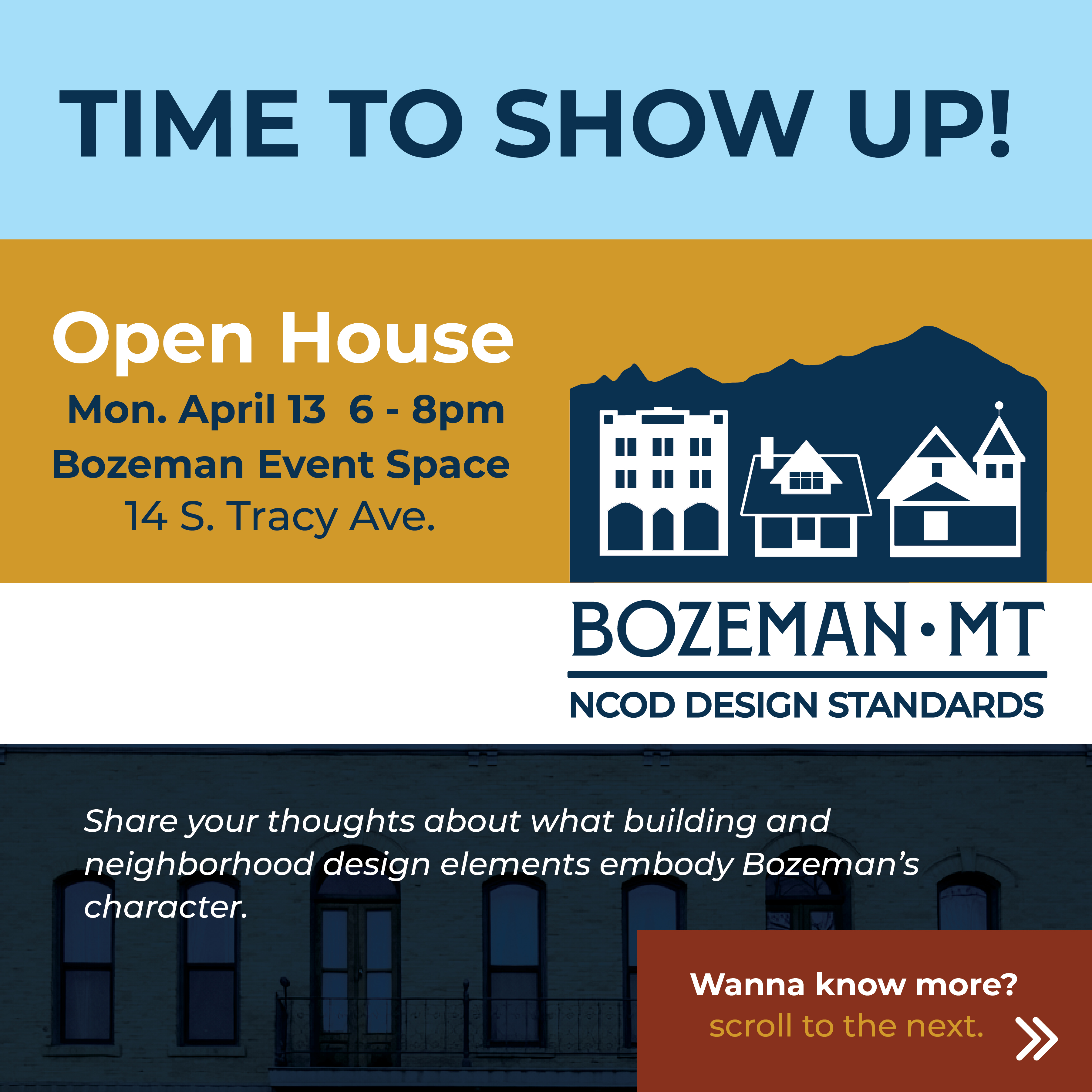
Have thoughts on development, historic preservation, or community character in Bozeman’s historic downtown and surrounding neighborhoods? We’re updating the way the City regulates building design in the area, also called the Neighborhood Conservation Overlay District or NCOD.
Join us for a Community Open House to share your experiences, ideas, and priorities for the future of the NCOD. Stop by the Bozeman Event Space (14 S. Tracy Ave.) on Monday, April 13 between 6pm-8pm to participate in interactive activities, including mapping exercises and discussion boards focused on what’s working well, and what could be improved.
Have thoughts on development, historic preservation, or community character in Bozeman’s historic downtown and surrounding neighborhoods? We’re updating the way the City regulates building design in the area, also called the Neighborhood Conservation Overlay District or NCOD.
Join us for a Community Open House to share your experiences, ideas, and priorities for the future of the NCOD. Stop by the Bozeman Event Space (14 S. Tracy Ave.) on Monday, April 13 between 6pm-8pm to participate in interactive activities, including mapping exercises and discussion boards focused on what’s working well, and what could be improved.
-
Community Engagement Plan Adopted
Share Community Engagement Plan Adopted on Facebook Share Community Engagement Plan Adopted on X (formerly Twitter) Share Community Engagement Plan Adopted on Linkedin Email Community Engagement Plan Adopted linkGathering input from the public is a large component of the NCOD Design Guidelines update and requires a community engagement plan to be adopted by the City Commission. The Historic Preservation Advisory Board provided input at their February 18 meeting and recommended approval to the CIty Commission. The City Commission adopted the Community Engagement Plan on March 10, 2026.
Public feedback and community input are key to the project's success and will be incorporated throughout the process. You can view the full Community Engagement Plan here.
Gathering input from the public is a large component of the NCOD Design Guidelines update and requires a community engagement plan to be adopted by the City Commission. The Historic Preservation Advisory Board provided input at their February 18 meeting and recommended approval to the CIty Commission. The City Commission adopted the Community Engagement Plan on March 10, 2026.
Public feedback and community input are key to the project's success and will be incorporated throughout the process. You can view the full Community Engagement Plan here.
-
July 28 2026
-
July 15 2026
-
July 09 2026
-
April 15 2026
-
April 15 2026
-
February-March 2026: Project Introduction
NCOD Design Guidelines Update has finished this stageIntroduce consulting team at Historic Preservation Advisory Board February meeting, discuss project timeline and approach, and give overview of Community Engagement Plan. Provide special presentation to City Commission introducing consulting group and reviewing Community Engagement Plan in March. Upon approval of the Community Engagement Plan, develop a Neighborhood Working Group that would consist of a representative from each neighborhood association located within the NCOD.
Meetings with a neighborhood working group which would consist of a representative from each neighborhood association that is located within the NCOD.
-
April: Community Engagement
NCOD Design Guidelines Update has finished this stageMeet with the public, citizen advisory boards, and external partners for feedback on existing design guidelines. Meetings can be organized into groups of residents and homeowners, business and property owners, developers and real estate professionals, architecture and design professionals, history and historic preservation organizations, etc. Meeting/working session with Historic Preservation Advisory Board. Meeting with Neighborhood Working Group.
-
May-July: Summarize Engagement Activities & Feedback
NCOD Design Guidelines Update has finished this stageSummary of community engagement activities, feedback and lessons learned included in Issues and Outline/Community Engagement Memorandum. Solicit feedback from City of Bozeman on first draft of memorandum and make revisions prior to sharing publicly.
-
July-August: Public feedback on Issues and Outline/Community Engagement Memorandum
NCOD Design Guidelines Update is currently at this stageSolicit feedback from Neighborhood Working Group and Historic Preservation Advisory Board on draft memorandum. Revise memorandum based on feedback received. Post final memorandum on Engage Bozeman.
-
July - September: Document drafting
this is an upcoming stage for NCOD Design Guidelines UpdateProject team develops Draft Design Guidelines. Solicit feedback from City of Bozeman on Draft Design Guidelines and revise prior to sharing publicly.
-
September: Public feedback on Draft Design Guidelines
this is an upcoming stage for NCOD Design Guidelines UpdateSolicit feedback on Draft Design Guidelines from Neighborhood Working Group and HPAB. Revise draft based on input received.
-
October - November: Final document drafting
this is an upcoming stage for NCOD Design Guidelines UpdateProject team develops final draft design guidelines Including finalizing all text, graphics/exhibits, and document layout and graphic design. Solicit feedback from City of Bozeman and make final revisions to design guidelines document. Post final document on Engage Bozeman.
-
November: Project Recommendations
this is an upcoming stage for NCOD Design Guidelines UpdatePublic hearings at Historic Preservation Advisory Board and recommendation to the City Commission.
-
December: Project Approval
this is an upcoming stage for NCOD Design Guidelines UpdatePublic hearing at Commission and approval of adoption.
-
 2026 Community Engagement
-
 Adopted Community Engagement Plan (699 KB) (pdf)
-
April 2026 Community Open House Presentation (7.7 MB) (pdf)
-
July 2026 Neighborhood Focus Group Presentation (3.06 MB) (pdf)
-
Online Survey - Open Ended Response Summary (142 KB) (pdf)
-
Online Survey - Complete Raw Data (1.68 MB) (pdf)
-
Community Open House - Exhibit Board Summaries (1.9 MB) (pdf)
-
Stakeholder Listening Session Summaries (779 KB) (pdf)
-
-
NCOD Info Sheet (753 KB) (pdf)
-
Existing NCOD Design Guidelines (6.1 MB) (pdf)
-
2025 Design Guidelines Recommendation from Local Landmark Phase 1 Report (209 KB) (pdf)
-
2019 NCOD Policy Recommendations (13.4 MB) (pdf)
-
2015 Final NCOD Report (11.9 MB) (pdf)
